
Use case · Healthcare & clinical research
Hear the patient’s story before the visit,
so your team starts prepared
Patients and study candidates answer your intake or pre-screening questions in a guided conversation, from home, in their own language. Your clinicians and coordinators read the transcript and summary first, and they make every decision.
The AI does not diagnose or decide eligibility. Your staff reviews every response.

The problem
Intake and pre-screening take time nobody has
Basic history and eligibility questions are the same every time, yet they fill appointments and phone queues.
Visits start with paperwork
The first minutes of an appointment go to questions the patient could have answered at home, leaving less time for the conversation that matters.
Forms miss the context
A checkbox says “chest pain: yes”. It doesn’t say when it started, what makes it worse, or what the patient is worried about.
Pre-screening calls don’t scale
Coordinators phone each potential participant to ask the same questions, often several times before they reach them.
How it works
Your questions, asked the same way every time
- 1
Describe the interview and write your questions
Explain who you are talking to and why, then write the questions in your own clinical or protocol wording. Add instructions for the interviewer, such as “don’t give medical advice”.
- 2
Try it as a participant
Take the interview yourself to hear exactly what patients will hear, and adjust any question that is unclear or too long.
- 3
Share one link after consent
Once consent is in place, send the link. Participants join in a browser with no account, whenever suits them, and the AI interviewer asks one follow-up when an answer is vague.
- 4
Your staff reviews every response
Each finished interview leaves a recording, a full transcript and a summary. Clinicians and coordinators read them before the visit or the screening call.
Example questions
What teams ask before a visit or a study
Examples to adapt with your clinical and research staff. Your team writes and approves the final questions.
- Pre-visit: What brings you in, and when did it start?
- Pre-visit: How has it changed over the past week, and is there anything that makes it better or worse?
- Pre-visit: Which medicines or supplements are you taking at the moment?
- Pre-visit: Is there anything you’d especially like to talk about with the doctor?
- Study pre-screen: What made you interested in taking part in this study?
- Study pre-screen: Would you be able to come in for visits every two weeks for three months?
Easier for participants
Patients answer when they’re ready, in their own words
No account, no app and no appointment slot. Participants open the link at home and talk through their answers, in any of 12 interview languages. A conversation leaves room for the details a form never asks for.
- One link, works in the browser
- One follow-up when an answer is vague
- Interviewer instructions of up to 500 characters
Ready for your staff
Read the summary before the visit, check the full answer when you need it
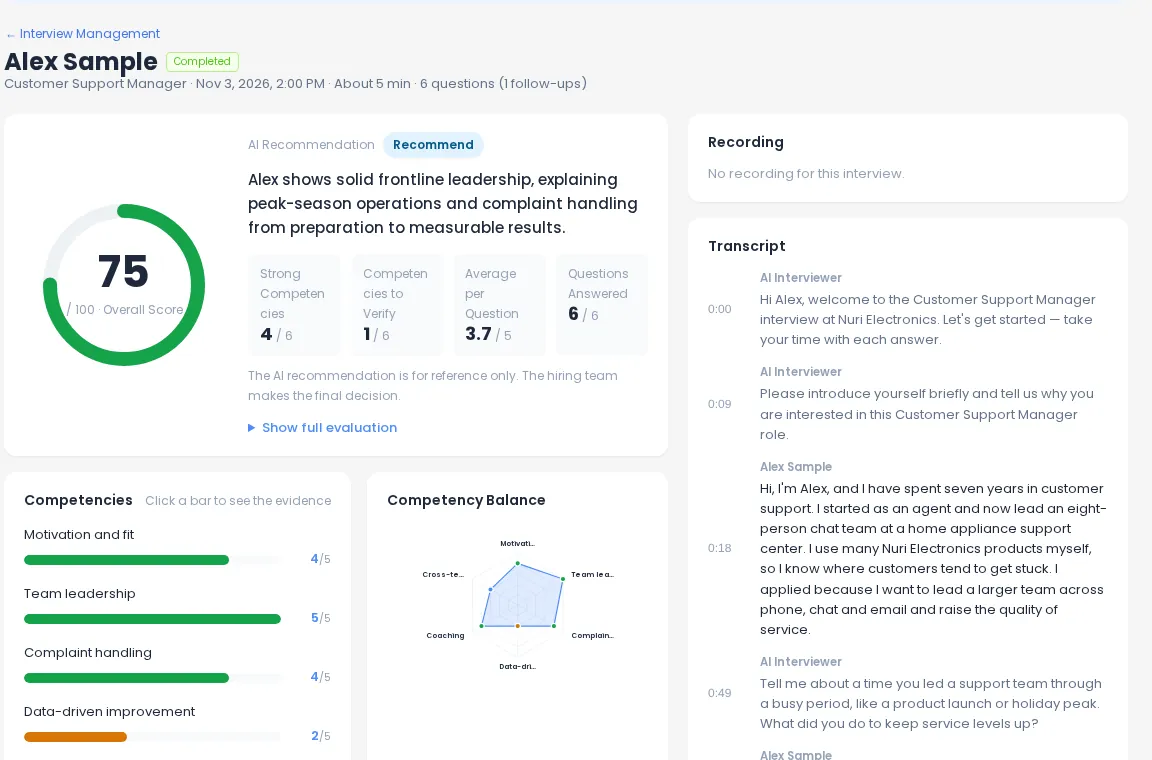
Each response comes with a recording, a full transcript, a summary and highlights of key answers. The report format was built for interviews, so treat any scores as a reading aid, not a clinical measure, and rely on the transcript.
- Recording and full transcript
- Summary and key-answer highlights
- CSV export and PDF save on Recruiter and up
When a paid plan makes sense
Test with your team, pilot with one clinic, then roll out
Start without real patient data, then talk to us before you go live.
Free: test the flow
5 interviews · 10 minutes total, once at sign-up. Try your questions with staff volunteers.
Contact salesRecruiter / Hiring Team: run a pilot
40 or 150 interviews a month, unlimited custom questions, bulk invites and reminders, CSV export. Hiring Team adds 5 seats and team comments.
See pricingEnterprise: roll out
Custom volume and more seats. Bring your consent, data-handling, security and integration questions to sales before launch.
Talk to salesHealthcare & research FAQ
Does the AI diagnose patients or decide trial eligibility?
No. The AI interviewer asks the questions your team wrote and records the answers. It does not diagnose, triage or decide who qualifies for a study. Qualified staff review every response and make every clinical and study decision.
Who writes the questions?
Your team does. Describe the purpose of the interview, then write the questions yourself so the wording matches your protocol or intake form. Free allows up to 5 custom questions; paid plans have no limit. You can also give the interviewer extra instructions of up to 500 characters.
Can we use it with patient health information?
Talk to sales before you collect any health information. We’ll walk through how interview data is stored, shared and exported so your privacy and compliance teams can decide. See the security page for what we publish today.
How do we get consent?
Collect explicit consent through your own process before you send the interview link, and tell participants that the interview is recorded and reviewed by your staff. AI Interview does not replace your consent procedure.
Do patients need an account or an app?
No. They open one link in a browser, at a time that suits them, in any of 12 interview languages. If an answer is vague, the AI interviewer asks one follow-up.
Can we try it before a pilot?
Yes. The Free plan includes 5 interviews · 10 minutes total, once at sign-up, with no card. Use it with staff volunteers and test questions only, not real patient data.
Start every visit with the story already heard
Talk to us about your intake or pre-screening process, or try the flow free with test questions.